
How to Search Cherokee County Criminal Records
Most criminal record lookups in Cherokee County begin in one of two places. Active and recent arrests show up first on the Sheriff's Jail List. Court filings, including indictments, accusations, and dispositions, run through the Clerk of Courts case-search portal. Patty Baker serves as Clerk of Courts. The case-search page allows lookup by case number, party name, or CSE number. The Sheriff's Jail List takes a partial name and returns recent bookings with charges and bond status. Both tools are official. Both come with disclaimers about data freshness and accuracy.
Case numbers in Cherokee follow court-coded formats. A Superior Court felony often looks like 25CR0962. A State Court misdemeanor reads 25M1191. A magistrate warrant number reads 25MW0561. Knowing the format helps narrow a search and read the docket once a hit appears. Probate, juvenile, and adoption matters are not on the criminal docket.
- Open the Cherokee Sheriff Jail List and enter part of the person's name to see recent bookings and current charges.
- Note the booking ID, arresting agency code, and any case or warrant number listed in parentheses next to each charge.
- Open the Clerk case-search portal and search by case number, party name, or CSE number to pull the docket.
- Click the "+" button to the left of a case number to view parties, court dates, judge assignment, and docket entries.
- Order a regular copy through the online portal, or visit the Clerk at 90 North Street, Suite G-170, Canton, for the certified file.
- For a statewide criminal history report, follow the GBI process under O.C.G.A. § 35-3-37 rather than relying on docket entries alone.
- If a case dates before mid-2010s digitization, call the Clerk's case-search problem line at 678-714-8778 to ask about retrieval options.
The Clerk warns that the online docket is a convenience tool, not the full file. Hidden pleadings with sensitive content stay blocked from the web. Those records are viewable only in office. Phone the Superior Court criminal division at 678-493-6508 or the State Court criminal/traffic line at 678-493-6550 for help locating a specific file.
Superior, State, and Magistrate Criminal Filings
Three Cherokee County courts hold criminal records, and the right starting point depends on the charge. Superior Court covers felonies and the most serious matters. State Court covers misdemeanors and traffic offenses, plus search and arrest warrants. Magistrate Court is the intake court that issues warrants, holds first appearances, and sets bail. The Clerk of Courts manages dockets for all three on the same case-search portal, but each division has its own filing rules and its own case-number format.
Knowing which court holds a file matters when ordering copies. Felony indictments and sentencing orders sit in Superior. Misdemeanor accusations and traffic dispositions sit in State Court. Magistrate Court records often include the original warrant, the bond order, and the first-appearance docket. A felony case may move through all three courts before reaching final disposition.
| Court | Case Types | Common Filings | Example Case Number |
|---|---|---|---|
| Superior Court | Felonies, major crimes | Indictments, pleas, sentencing orders, revocations | 25CR0962 |
| State Court | Misdemeanors, traffic, county-level criminal | Accusations, plea sheets, pretrial orders, fines | 25M1191 |
| Magistrate Court | Warrants, first appearances, bail | Warrants, bond orders, preliminary hearings | 25MW0561 |
Magistrate Court operates 24 hours a day, 365 days a year for warrants, first appearances, and bail. Every person booked into the Adult Detention Center flows through the Magistrate intake process. For broader case research, the Cherokee County court records page covers civil and family files alongside criminal.
Cherokee County Arrest Records and the Jail List
Arrest records start with the Sheriff or a city police booking team. Sheriff Frank Reynolds runs the Adult Detention Center at 498 Chattin Drive, Canton. The ADC is the only full-service jail in Cherokee County. It books arrestees from the Sheriff's Office, Canton Police, Woodstock Police, Holly Springs Police, Ball Ground Police, Georgia State Patrol, the Department of Natural Resources, and the School District Police. Each arrest creates a booking record. Each booking is searchable on the Jail List shortly after intake.
The Sheriff's official Jail List does not show a static daily total. It returns recent inmates whose names match a search string. Each result lists an inmate ID such as P00003961, a booking ID such as 262547, the name, the date of birth, the booking date, and the arresting agency code. Common codes include CPD for Canton Police, CCSO for Cherokee County Sheriff, WSPD for Woodstock Police, and GSP for Georgia State Patrol. Charges appear with the offense text and a case or warrant number in parentheses. Bond status appears with a code such as NO or BREF and a per-charge bond amount.
The Jail List is informational. The Sheriff disclaims accuracy and warns the public not to rely on it for legal action. An arrest does not mean a conviction. For someone currently in custody, use the Cherokee County inmate records page for visitation, mail, and commissary details. For people no longer on the active list, the released inmates page covers state and federal locators plus victim notification through VINELink.
Note: The Cherokee Sheriff's Office will not collect or solicit payment for warrants or fines by telephone or through any automated service.
What Cherokee County Criminal Records Show
A Cherokee County criminal record is a bundle of data points pulled from the booking system and the court docket. Some fields come from the Sheriff at the moment of arrest. Other fields are added by the Clerk after charges are filed. Disposition and sentence are added at the end of the case. Background-check users should read the full record rather than stopping at the arrest line.
| Field | What It Shows |
|---|---|
| Case Number | Court-coded ID such as 25CR0962 (Superior) or 25M1191 (State) |
| Filing Date | Date the indictment, accusation, or warrant was filed |
| Charging Document | Indictment for felonies; accusation for misdemeanors; warrant for intake |
| Arresting Agency Code | CCSO, CPD, WSPD, GSP, or other code from booking |
| Booking Date | Date and time the person was booked into the ADC |
| Bond Type | Codes such as NO or BREF; display logic may read "No Bond" |
| Bond Amount | Per-charge dollar amount set by the magistrate |
| Disposition | Plea, verdict, dismissal, nolle prosequi, or dead docket status |
| Sentence | Probation, jail or prison term, fines, restitution, conditions |
Not every field appears on every record. Hidden pleadings and sensitive attachments do not display online. Redactions cover Social Security numbers, financial account numbers, protected identifiers, minor information, and home addresses for judges and officers. To pull a full file with attachments, the Clerk takes copy requests in person or by mail.
Charges vs. Convictions
A charge is not a conviction. The two sit at different stages of a case and carry different legal weight. A charge means a prosecutor or a magistrate found enough cause to file. A conviction means the case ended in a guilty plea or a guilty verdict. Both are public records in most cases, but they read very differently to a background-check reviewer or a future employer.
| Topic | Charges | Convictions |
|---|---|---|
| What It Means | The State has filed an allegation. Guilt has not been proven. | A judge or jury has resolved the case against the defendant. |
| On the Docket | Appears as indictment, accusation, or warrant entry | Appears as plea sheet, verdict, sentencing order, or judgment |
| On a Background Check | May show as pending, dismissed, or open | Shows the offense, sentence, and any probation or restitution |
| Can Be Restricted | Often yes, if the case was dismissed or did not result in conviction | Limited; most convictions stay on the record unless pardoned |
A dropped charge can still appear on Cherokee County criminal records if no restriction was ever filed. That is why people seek record restriction under Georgia law. The Solicitor-General also runs accountability programs that can change a final disposition for eligible defendants.
For a deeper look at the docket flow, see the Cherokee County court dockets page. Traffic-related criminal cases, such as DUI and reckless driving, also show up on the traffic court records page.
Sealed, Restricted, and Juvenile Criminal Records
Georgia does not use the term expungement in the way many other states do. The state uses record restriction. Restriction limits access to a criminal history for non-criminal-justice purposes. The court file itself stays open unless a judge enters a separate sealing order under Uniform Superior Court Rule 21. That two-track structure confuses many people. The arrest can be restricted from background checks while the underlying court docket remains visible to the public.
Juvenile records sit outside the adult criminal system. Under O.C.G.A. § 15-11, juvenile court records are restricted by law. They are not equivalent to adult public criminal dockets. Access generally belongs to parties, attorneys, agencies, and persons authorized by court order. Adoption case files are also restricted. The Court Administrator's adoption page says clerks and staff are prohibited from giving out copies or information about adoption cases.
| Question | Sealed (Court File) | Restricted / Expunged (Criminal History) |
|---|---|---|
| Legal Basis | Uniform Superior Court Rule 21 | O.C.G.A. § 35-3-37 (record restriction) |
| What It Hides | Court pleadings and orders in the file | Arrest entries on the GCIC criminal history |
| Who Decides | Judge after motion, hearing, and harm finding | Prosecutor or arresting agency, by statute |
| Public View | Hidden from the docket once sealed | Removed from public criminal history reports |
| Georgia Uses | Sealing under Rule 21 procedure | Record restriction, not full expunction |
Family violence protective orders also receive special handling. Uniform Superior Court Rule 21.6 places protected identifiers on a sealed page that does not appear in the public file. Hidden pleadings with sensitive data are blocked from the internet and must be viewed in office.
Record Restriction under O.C.G.A. § 35-3-37
Georgia's record restriction process is run through the prosecutor or the arresting agency depending on the date of the arrest. The Georgia Bureau of Investigation explains the rules and posts the forms. The Cherokee Sheriff's Office maintains a local restriction page with a three-section form. Both pages should be reviewed before starting a request. Eligibility depends on the disposition of the case, not just the date.
The GBI page lays out Georgia criminal history record restrictions in plain terms. View it on the GBI record restriction page for the official statewide rules and forms. The page makes clear that Georgia generally restricts rather than fully erases.
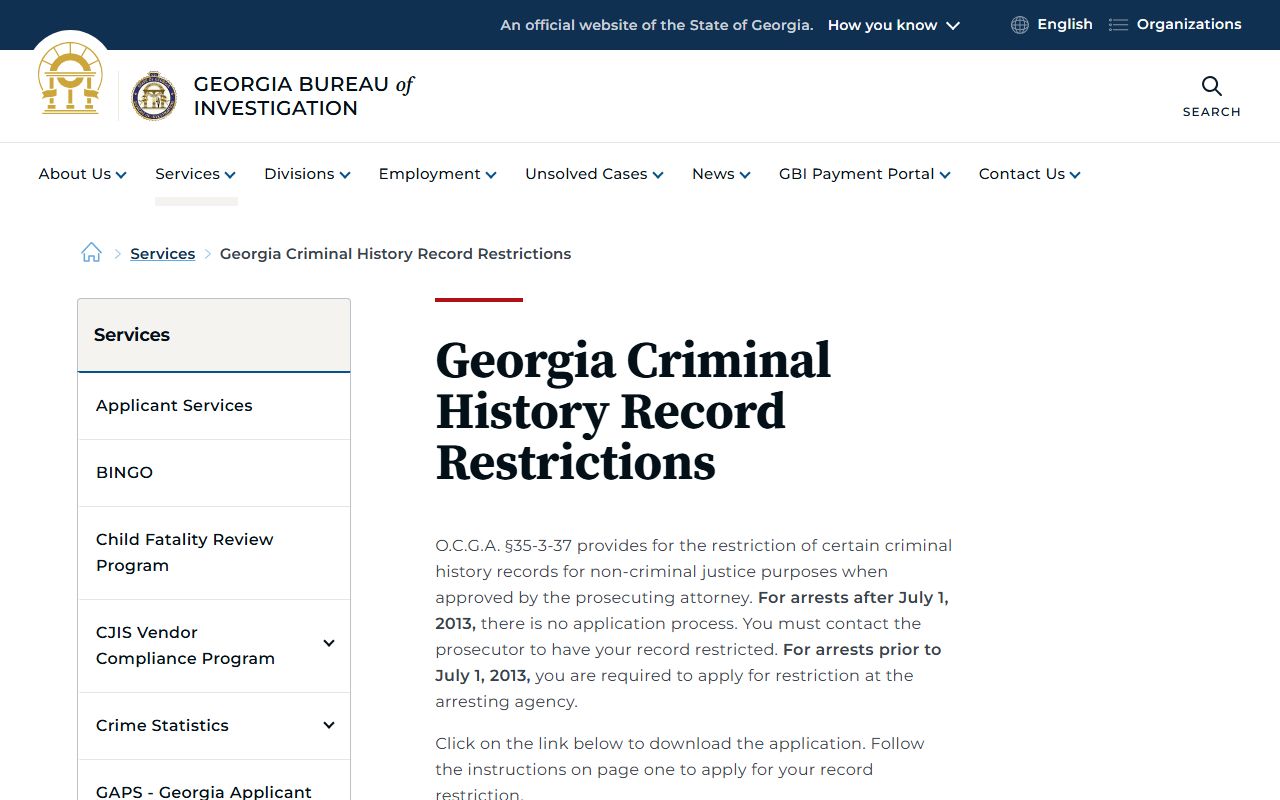
The GBI screen confirms the post-July 1, 2013 cutoff and explains why the older application process no longer applies to recent arrests. The Cherokee Sheriff's Office posts its own three-section form for local cases. The Sheriff's criminal record expungement and restriction page walks through who fills out each section.
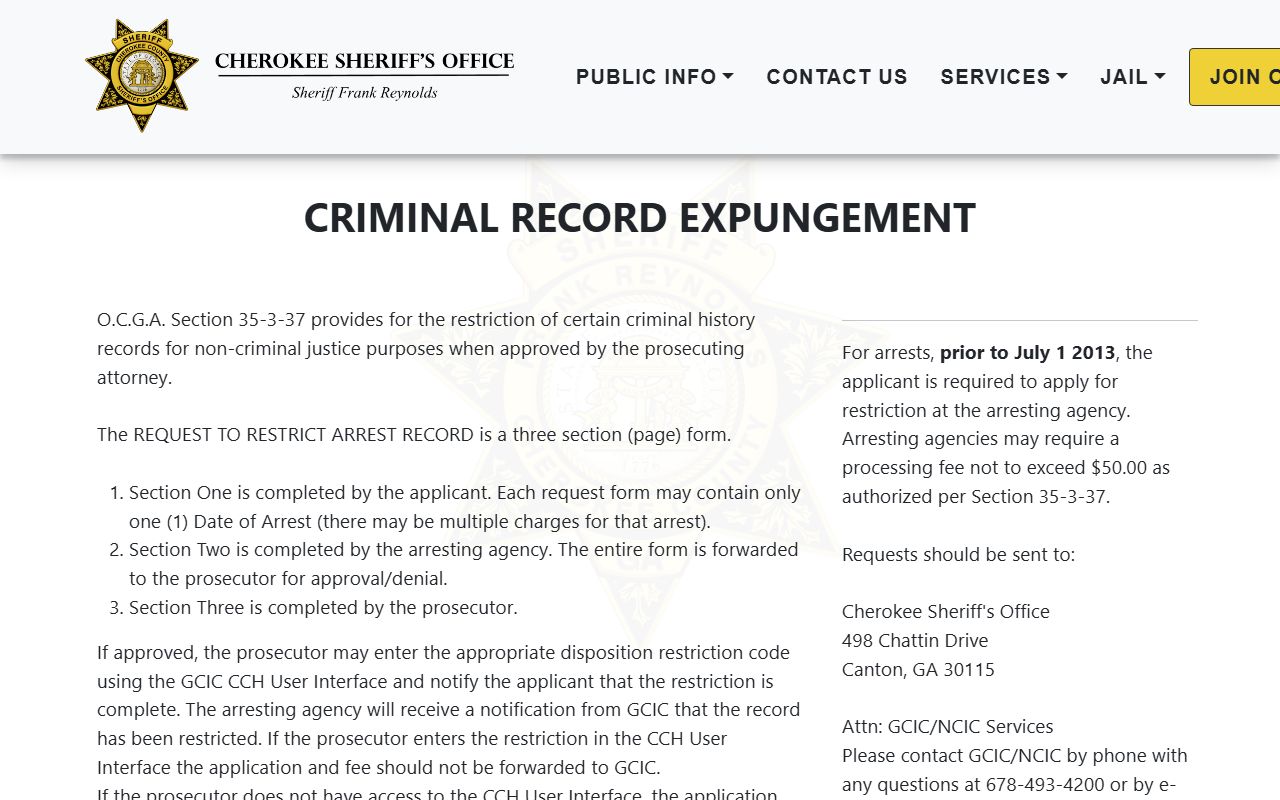
The page shows the local Request to Restrict Arrest Record and where to send each section. Section One is the applicant. Section Two is the arresting agency. Section Three is the prosecutor. Common reasons for denial include conviction, pending prosecution, ineligible disposition, missing arrest data, or prosecutor objection.
- Confirm the arrest date. Post-July 1, 2013 arrests go straight to the prosecutor. There is no GBI application step. Pre-July 1, 2013 arrests start at the arresting agency.
- Fill out Section One on the Sheriff's three-section form. The arresting agency completes Section Two and forwards the form to the prosecutor. The prosecutor completes Section Three.
- If approved, the prosecutor enters the disposition restriction code in GCIC and notifies the applicant. The arresting agency receives a GCIC update. If denied, the applicant gets a reason.
Note: Court-file sealing under Uniform Superior Court Rule 21 is a separate step and requires a written motion, a hearing, and a judge's harm finding.
Cherokee County DA, Solicitor-General, and Indigent Defense
Three offices handle the prosecution and defense side of Cherokee County criminal records. The District Attorney prosecutes felonies. The Solicitor-General prosecutes misdemeanors in State Court. Indigent Defense provides appointed counsel for defendants who qualify. Each office has its own phone line and its own role at every stage of a case.
District Attorney Susan K. Treadaway leads the Blue Ridge Judicial Circuit prosecution office. She was sworn in on June 1, 2023, after years as a felony prosecutor. The office runs a Victim Witness Assistance Program with notification, courtroom support, parole notice, and help with Victim Impact Statements. The DA's office page covers victim services in detail at the DA victim services portal.
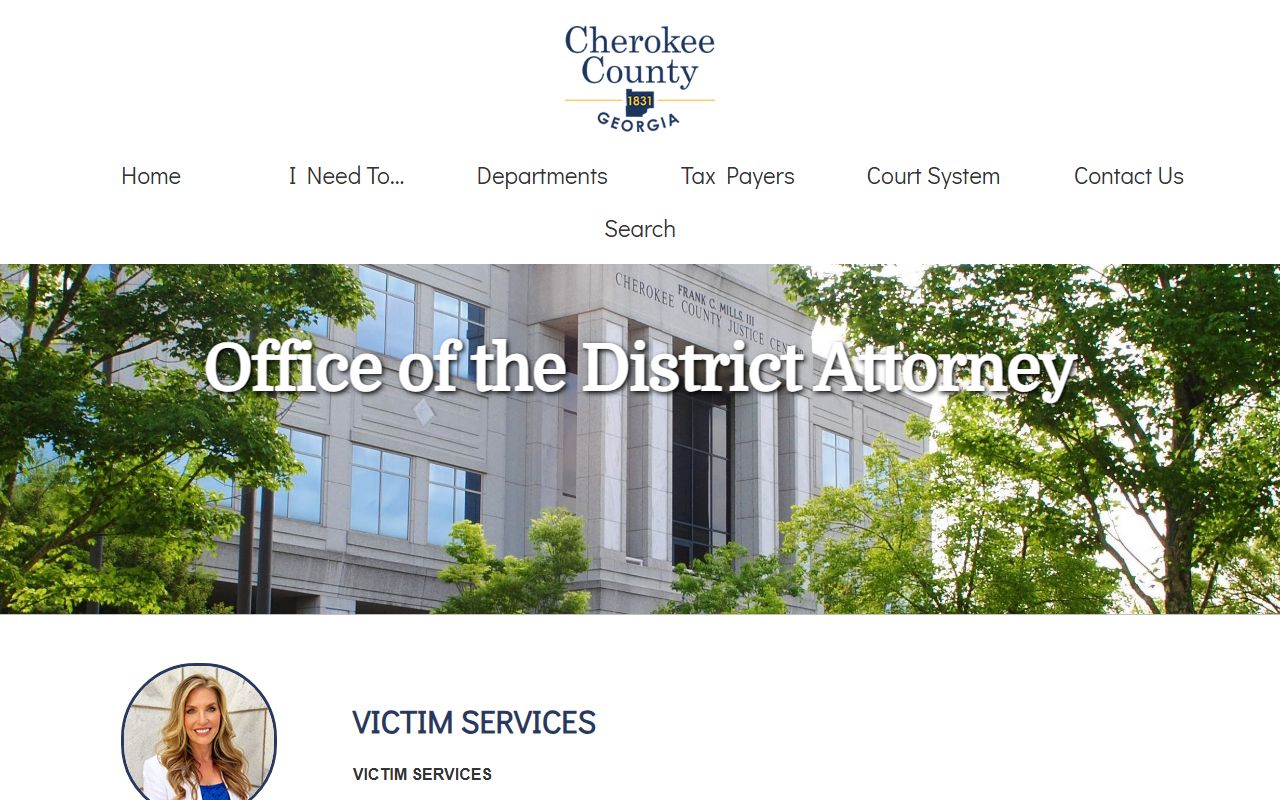
The page lists the third-floor location of the victim services unit at the Justice Center and a direct advocate line at 770-479-1488. The DA's main office sits at 90 North Street, Suite 390, Canton, GA 30114. The main DA line is 678-493-6300. Victim services is on the third floor.
Cherokee County District Attorney
Susan K. Treadaway, District Attorney
Blue Ridge Judicial Circuit
Cherokee County Justice Center
90 North Street, Suite 390
Canton, GA 30114
Main: 678-493-6300
Victim Services: 770-479-1488
Hours: Monday-Friday, 8:00 a.m.-5:00 p.m.
Solicitor-General Todd Hayes runs the misdemeanor prosecution office. The Solicitor handles DUI, simple battery, shoplifting, and other county-level crimes. The Solicitor's law enforcement helpful links page collects key phone numbers in one place.
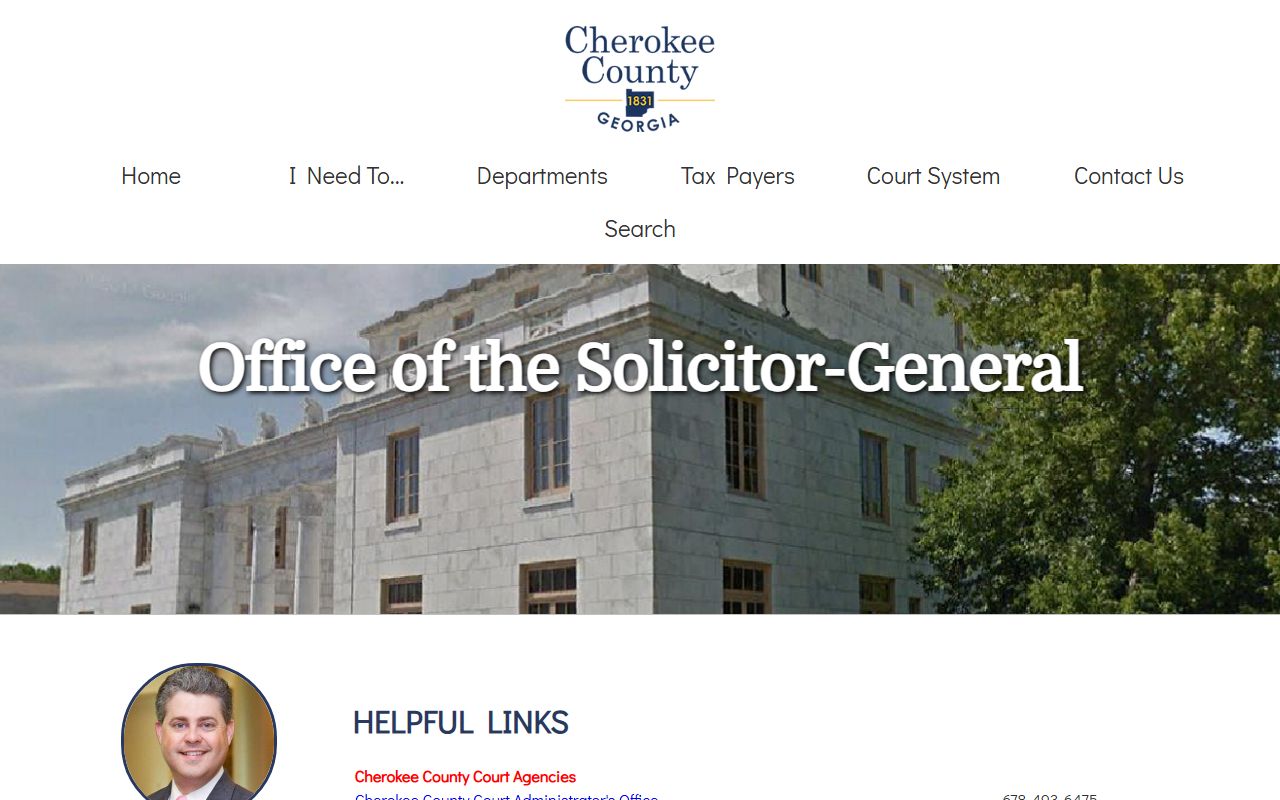
The page lists DA 678-493-6300, State Court Clerk 678-493-6511, DUI-Drug Court 678-493-6450, Indigent Defense 678-493-6193, and TAC 678-493-6581. The Solicitor's own number is 678-493-6360. The Treatment Accountability Court runs out of the Solicitor's office with coordinator Ethan Childers and presiding judge Hon. Shannon Wallace. TAC is an 18-month minimum program for defendants whose criminal charges relate in part to mental illness.
Indigent Defense provides court-appointed counsel under the Georgia Public Defender Standards Council. The county Indigent Defense office page hosts the local application and contact details.
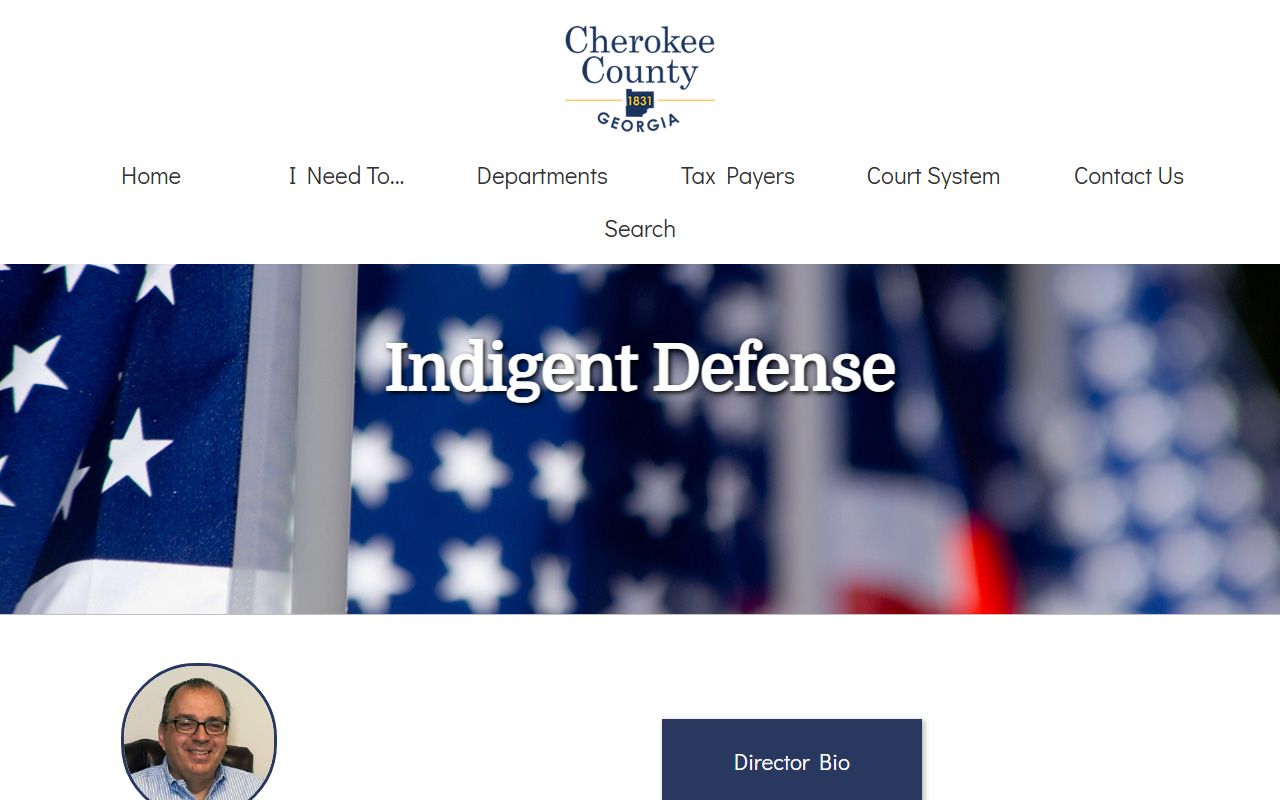
The page acts as the entry point for indigent applicants and confirms the 678-493-6193 line for the office. Financial eligibility is set by the Standards Council. Defendants charged with serious offenses should call as early as possible after arrest.
Bond, Bench Warrants, and First Appearances
Bond, bench warrants, and first appearances are the points where Cherokee County criminal records start to take shape. Magistrate Court is the intake court for all three. Magistrate Court runs 24 hours a day, 365 days a year. Every person booked into the ADC gets a first appearance with a magistrate judge. The judge reviews the charges, advises the defendant of rights, and addresses bail.
Bond types in Cherokee County records typically show on the Jail List as a short code. NO often displays as "No Bond." BREF displays as bond off bond or bond refused, depending on the charge. Other charges carry a dollar amount set by the magistrate. Cash, surety, and property bonds may be allowed depending on the offense and the defendant's criminal history. Felony cases involving violent offenses may require a Superior Court judge to set the bond rather than a magistrate.
A bench warrant is issued by a judge, often for failure to appear. The Sheriff's Warrant/Civil Unit serves and maintains all local warrants. The unit also assists other counties with serving warrants and arranges felony extraditions from out of state. For active warrants and the warrant search process, see the dedicated Cherokee County warrant records page. The Drug Lab at the Historic Courthouse, 100 North Street, Suite G23, supports court monitoring for the DUI/Drug Court and TAC programs.
Georgia open-government rules apply to most criminal court records. The Attorney General's open government FAQ sets the response-time and fee limits for record requests. The county public records page covers how to file a written request, the three-business-day response rule, and the 25-cent-per-page copy cap. For full case file access at the Clerk's office, the Clerk of Courts page lists copy fees and certified-copy steps. For a court-by-court breakdown, see the Superior Court page and the FAQ for quick answers.