
How to Search Cherokee County Traffic Court Records
The main path runs through the State Court Clerk. The State Court Clerk's office page lists the rules for traffic citations and links the online payment portal. State Court handles misdemeanor traffic, including most moving violations written by the Georgia State Patrol, Cherokee Sheriff's Office, and the city police agencies that book into the county. The Clerk's site also feeds into the broader Cherokee County Clerk of Courts case-search system, which covers Superior, State, and Magistrate dockets.
Before starting a lookup, gather the citation number from the ticket, the driver's full name as it reads on the license, and the date of the stop. The court date and the issuing agency code help when more than one match comes back.
A short walk-through covers most cases.
- Open the State Court Clerk page at cherokeecourtclerk.com/state-court-clerks-office.
- Click the linked traffic payment portal, which uses the FivePoint payment system for online traffic payments.
- Enter the citation number exactly as printed on the ticket, then add the driver's name if asked.
- Review the case posture. Look for charge, court date, fine amount, and any "must see judge" flag.
- Pay online if the citation is payable, or note the court date and plan to appear.
Lead-in to the Clerk's State Court page below, which lays out the same rules in the county's own words: see the State Court Clerk page.
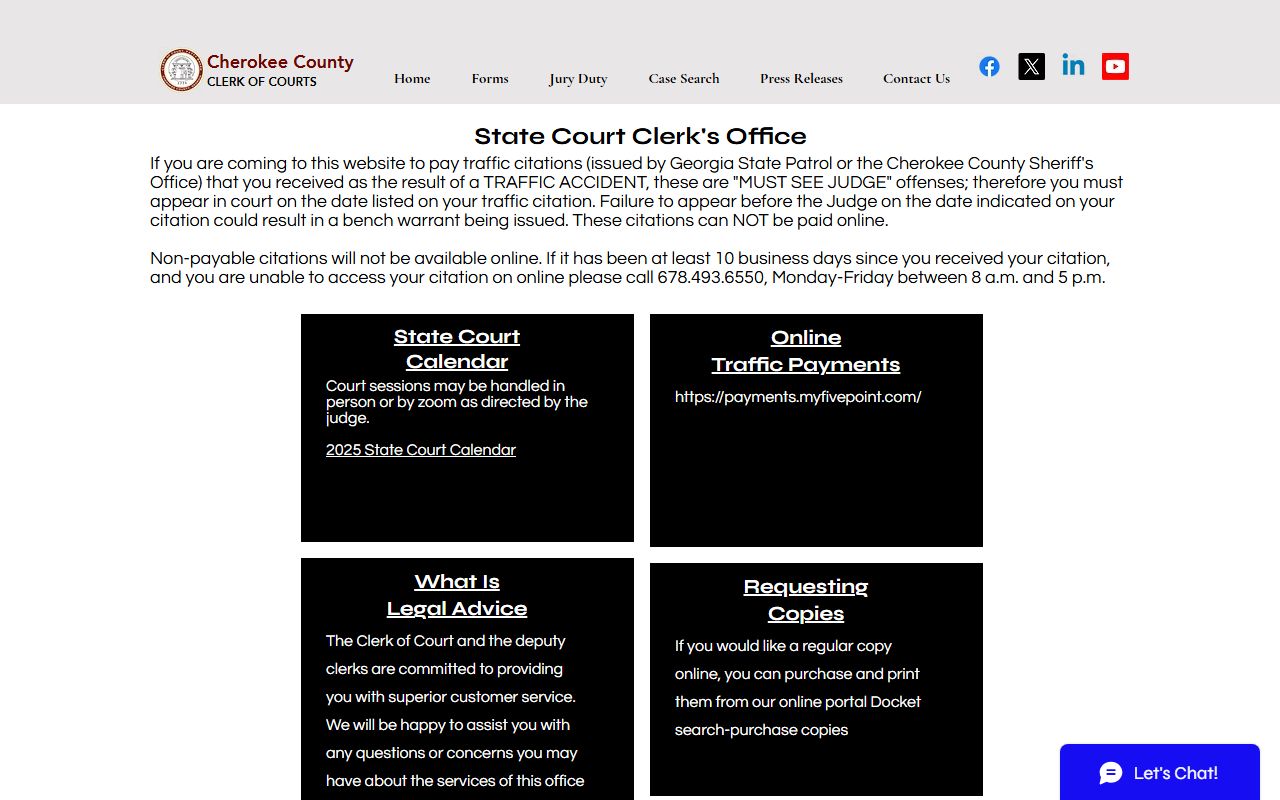
The screenshot shows the Clerk's note on which citations are payable, which require a court date, and the link out to the FivePoint payment system. Note: if at least ten business days have passed since the citation and it still cannot be found online, call the Clerk's case-information line at 678-493-6550.
Which Courts Handle Traffic Cases in Cherokee County
State Court is the main traffic court in Cherokee County. It hears misdemeanor traffic cases, the bulk of moving violations, and minor traffic offenses tied to county-level law enforcement. The Solicitor-General prosecutes those cases. Todd Hayes is the Solicitor-General and his office is reached at 678-493-6360. The State Court Clerk maintains the case files and handles payments.
City courts split off a slice of the traffic load. Canton, Woodstock, Holly Springs, and Ball Ground each run a municipal court that hears tickets written inside city limits. Those courts handle their own dockets and use their own clerks. A ticket written by a Canton Police officer on a city street usually starts in Canton Municipal Court. A Sheriff's deputy stop on a county road usually routes to State Court. Magistrate Court is the 24/7/365 intake court at 90 North Street and handles warrants, first appearances, and bail for any drivers who get booked. It is not the traffic trial court.
Two paths cover most situations.
| Court | Traffic Cases Handled | Who Prosecutes |
|---|---|---|
| State Court (Cherokee) | Misdemeanor traffic, DUI, most moving violations from GSP, CCSO, and county agencies | Solicitor-General Todd Hayes |
| Municipal Court (Canton, Woodstock, Holly Springs, Ball Ground) | Tickets written inside city limits; local ordinance traffic | City solicitor |
| Magistrate Court | Warrants, first appearances, bail after a traffic arrest | n/a (intake court) |
For the central State Court contact, the county's own State Court contact page lists hours and the case-information phone line.
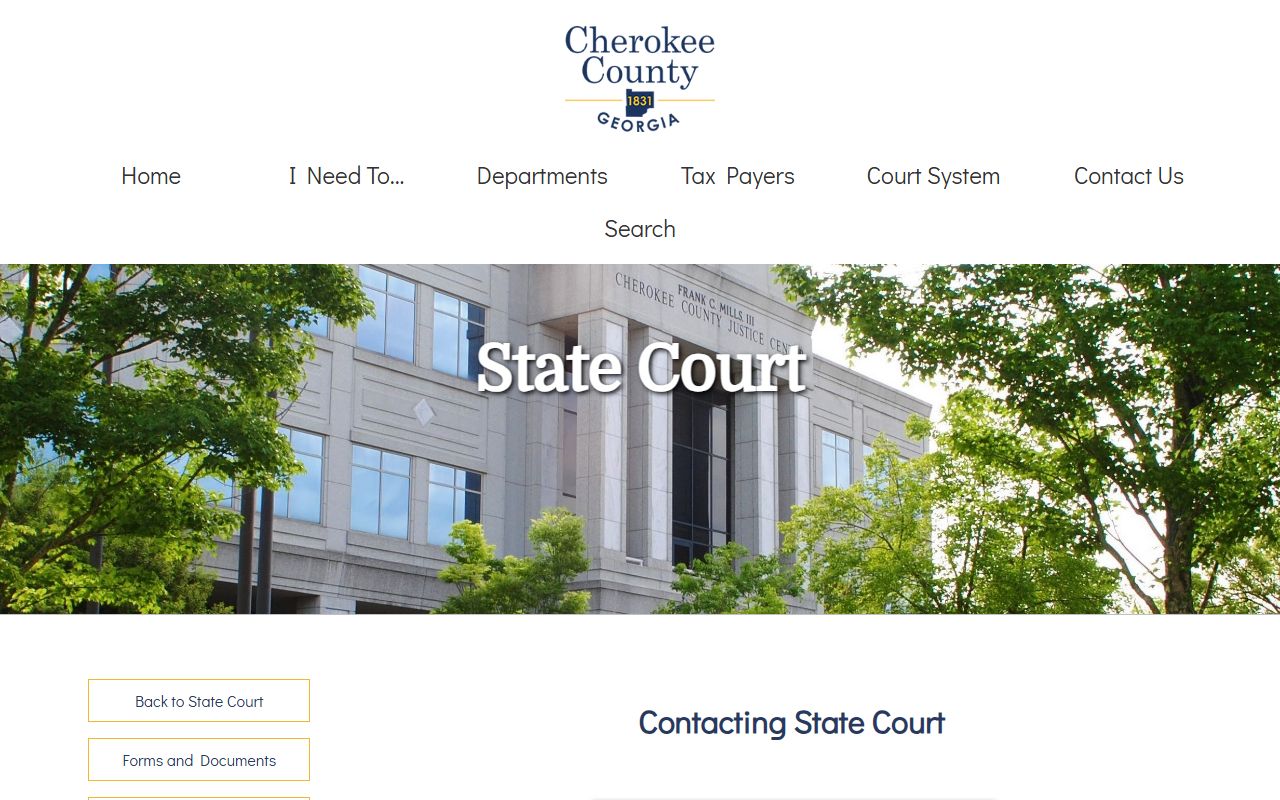
The same page shows the State Court Clerk address at 90 North Street in Canton and confirms the criminal and traffic phone line at 678-493-6550. Use that line when the online portal will not return a record.
Types of Traffic Cases on Record
Traffic files in Cherokee County run from minor paper violations to serious crimes. A speeding ticket, an expired tag, or a missing seat belt are typical low-level cases. A reckless driving charge, a no-insurance cite paired with a wreck, or a DUI is a different tier. The same court keeps records for all of them. The label on the citation, the bond rules, and the court date drive what happens next.
The records also reflect the agency that wrote the ticket. The arresting-agency code on the case shows which department was on scene.
- Moving violations. Speeding, failure to yield, running a stop sign, improper lane change, following too close.
- Non-moving violations. Equipment violations, expired tag, no proof of insurance.
- Accident-related citations. Tickets tied to a crash. The Clerk flags these as must-see-judge offenses.
- Commercial vehicle and CDL. Weight, log-book, and CDL-driver moving violations, which carry stiffer federal reporting rules.
- Serious traffic offenses. DUI, reckless driving, hit-and-run, fleeing or attempting to elude, vehicular homicide.
- Juvenile traffic. Tickets written to drivers under 17 may route through Juvenile Court instead of State Court.
The court file shows what was charged. The driver record kept by DDS shows what was convicted. The two will not always line up, especially when a plea reduces a charge.
What Cherokee County Traffic Court Records Show
A State Court traffic case file is a working record. It shows what was written, what the judge ordered, what was paid, and how the case ended. The Clerk's online search exposes the basic posture. The full file lives at the Clerk's office at 90 North Street.
The most useful fields for a public lookup are listed below.
| Field | What It Shows |
|---|---|
| Citation Number | Unique ID printed on the ticket. The primary search key in the online portal. |
| Officer Agency | The department that wrote the cite. Codes seen in Cherokee data include GSP, CPD (Canton PD), CCSO (Sheriff), and WSPD (Woodstock PD). |
| Date and Time of Citation | When the stop happened. Sets the clock for court date and any pay-by date. |
| Charge / Offense | The specific Georgia statute or county ordinance cited. |
| Court Date | Scheduled hearing in State Court or city court. Missing this date can trigger a bench warrant. |
| Court and Judge | Which court will hear the case and which judge is assigned. |
| Disposition | Paid, dismissed, nolle prosequi, must-see-judge, found guilty, plea, deferred. Open cases show as pending. |
| Fine | The amount due if the cite is payable, or the fine assessed at sentencing. |
| Bond | If the driver was booked, any bond amount and bond type from the Magistrate file. |
Hidden pleadings tied to sensitive data are blocked from the web under Clerk policy and Uniform Superior Court Rule 21.6. Those filings can be viewed in person at the Clerk's office on weekdays.
Searching by Citation Number vs by Name
The State Court Clerk's online portal accepts a citation number as the cleanest search key. A citation number returns one case. A name search may return many, especially for common names. Pair a name with a date range or with the driver's date of birth if the form offers that field. Exact spelling matters. The portal does not publish wildcard rules.
The portal labels can shift between releases. The table below covers the fields a driver should expect.
| Field | Type | Required | Notes / Format |
|---|---|---|---|
| Citation Number | text | Required for citation lookup | Printed on the ticket. The exact label may vary on the portal. |
| Driver's Name | text | Optional | Use Last Name, First Name. Pair with a date if results look too broad. |
| License Plate or VIN | text | Optional | Helpful when the citation number cannot be found. |
If at least ten business days have passed since the citation and the case still will not load, call State Court Clerk at 678-493-6550 Monday through Friday during business hours. Non-payable citations will not appear in the online portal at all and must be handled in court.
Note: an exact citation number search is the fastest way to confirm a fine and court date in Cherokee County traffic court records.
Paying or Contesting a Cherokee County Traffic Ticket
Most payable State Court citations can be cleared online. The Clerk routes payments through the FivePoint payment portal linked from the State Court Clerk page. Cash, money order, and card payments are accepted at the Clerk's window during normal hours. A guilty or nolo plea by payment closes the case and reports the conviction to DDS for the driver record.
Contesting a ticket means showing up in court on the scheduled date. State Court traffic dockets are set by the Solicitor-General's office. A driver can plead not guilty, request a bench trial, or, in many cases, ask for a jury trial. The Solicitor will negotiate pleas at the calendar call. An attorney is not required, but is allowed.
A general step-by-step covers both paths.
- Read the back of the ticket. Confirm the court date and the pay-online flag.
- Look up the case at cherokeecourtclerk.com/state-court-clerks-office to confirm the charge and the fine.
- To pay, click the FivePoint payment link and enter the citation number. Pay the full amount or the listed plea-by-mail amount.
- To contest, do not pay. Show up at the State Court calendar call on the scheduled date.
- Decide on a plea: not guilty, guilty, or nolo contendere. The Solicitor may offer a reduced charge or a defensive driving option.
- If a trial is set, the case is scheduled for a bench trial or jury trial on a later date.
- Pay any fine, complete any class, and ask the Clerk for proof of disposition for insurance or DDS purposes.
Must-See-Judge Rule. Accident-related citations written by Georgia State Patrol or the Cherokee Sheriff's Office cannot be paid online. The State Court Clerk page calls these "must see judge" cases. Failure to appear on the assigned court date may result in a bench warrant.
Public Access Laws for Traffic Court Records
Georgia treats court records as public by default. Uniform Superior Court Rule 21 sets that starting point for trial court files, and State Court follows the same rule for traffic case files. The Open Records Act, found at O.C.G.A. § 50-18-70 through § 50-18-72, governs broader access to non-court government records. The Georgia Attorney General publishes an explainer on the Open Records Act with the statute text and an Open Government FAQ.
Some pieces of a traffic file get redacted. Social Security numbers, bank account data, the driver's birth month and day, and protected home addresses for law enforcement are limited. Juvenile traffic is restricted by separate juvenile law and is not part of the adult public docket. Sealed cases follow the Rule 21 motion procedure.
Note: a request to limit court file access must be filed under Rule 21, with notice and a hearing. Casual requests do not seal a traffic record.
Court Traffic Records vs State Driver Records
The county court file and the state driver record are two different things. The State Court file is the case record. It shows the citation, the plea, and the sentence. The Georgia Department of Driver Services keeps the Motor Vehicle Report, often called the driver history or MVR. The MVR shows convictions, points, license status, and any suspension data. A correction to one does not auto-correct the other.
The split matters for jobs, insurance, and CDL holders. An employer or insurer almost always pulls the DDS driver record, not the county court file. The county court file is the source of truth for what happened in court. The DDS record is the source of truth for the driver's license status.
| Record Source | What's In It | Where to Access | How to Correct Errors |
|---|---|---|---|
| Cherokee County State Court traffic file | Citation, charge, plea, fine, court date, disposition, bond | State Court Clerk online portal and the Clerk's office at 90 North Street | Motion in State Court; ask the Clerk for the docket entry to fix. |
| Georgia DDS driver record (MVR) | Convictions, points, license status, suspension/reinstatement | dds.georgia.gov driver record service | Contest the underlying court case; then ask DDS to update the MVR based on a corrected disposition. |
The lead-in below sits next to the official Georgia DDS home page, which hosts the driver record service and licensing tools.
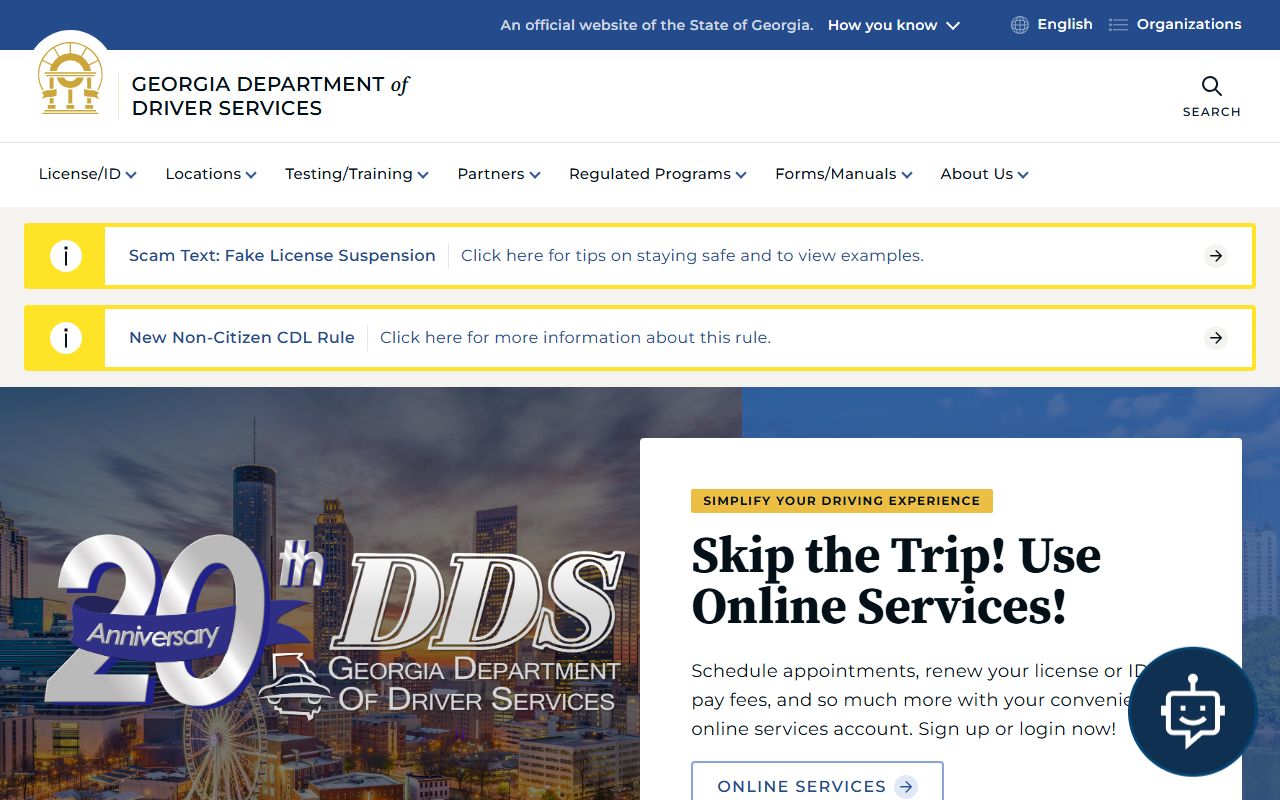
The DDS portal handles MVRs, license reinstatement, CDL endorsements, and identity services. None of those replace the State Court file kept by the Cherokee Clerk.
CDL and Commercial Driver Records
Commercial driver rules are stricter. A CDL holder in Cherokee County cannot mask a traffic conviction by pleading nolo contendere on most moving violations. Federal law treats CDL convictions as reportable to the home state, and Georgia DDS posts them on the MVR. Even a personal-vehicle ticket can affect a CDL.
The court file looks the same as a non-CDL traffic case, but the consequences spread further. Serious violations such as DUI, leaving the scene, or driving while disqualified can trigger a one-year CDL disqualification on a first offense. A second serious violation can trigger a lifetime disqualification under federal rules.
Drivers with a CDL should look at the court file and the DDS record together, since the state record is what employers and the FMCSA Clearinghouse use.
DUI / DWI Cases
DUI files start at the same booking step as other traffic, but the court track is heavier. State Court handles most misdemeanor DUI cases in Cherokee County. Felony DUI moves to Superior Court. The Solicitor-General prosecutes misdemeanor DUI. The County also runs a DUI/Drug Court accountability program with a separate docket for participants. The DUI/Drug Court line is 678-493-6450.
The court record for a DUI looks like other traffic records but with more entries: arrest report, implied-consent paperwork, breath or blood result, bond order, motions, plea, and sentence. The DDS driver record will reflect the conviction with a license suspension and reinstatement steps.
For full Cherokee County DUI case information, see Cherokee County criminal records. Warrant and bond information lives on the warrant records page, and the booking record lives on inmate records.
Deferred Adjudication and Defensive Driving Course
Georgia drivers can sometimes avoid a conviction by completing a defensive driving course or by entering a nolo contendere plea. Nolo can be used once every five years for most traffic charges in Georgia and may keep points off the DDS record at the judge's discretion. Drivers under 21 face tighter rules. The State Court judge has discretion to grant or deny the request.
A defensive driving course is a separate option. Some courts will reduce the fine or remove points if a driver completes a state-approved class. The Clerk or the Solicitor's office can confirm whether a class is on the table for a given citation. Class costs and providers vary; the state-approved provider list lives with DDS.
Note: deferred and nolo options are not automatic and must be asked for in court, usually at calendar call or arraignment.
Sealing or Expunging Traffic Records
Georgia uses the term "record restriction" instead of expungement for most criminal history. The controlling statute is O.C.G.A. § 35-3-37. For arrests after July 1, 2013, the request goes to the prosecutor. For arrests before that date, the request goes to the arresting agency. Convictions on a traffic citation usually cannot be restricted, but dismissals, nolle prosequi outcomes, and not-guilty findings often can be.
The Cherokee Sheriff's criminal record expungement page walks through the three-section restriction request. The Georgia Bureau of Investigation also explains criminal history record restrictions in plain language. Court file sealing is a separate process under Uniform Superior Court Rule 21.
A driver who wants to clear a court file should look at both tracks. Restriction limits who can see the GCIC record. Sealing limits who can see the court docket. The two are filed differently.
Fees for Traffic Record Copies
Court copy fees in Georgia are set by statute. The Clerk's forms page includes Traffic Citation Mail-In Instructions and other State Court materials. Subpoena fees for State Court are set on the Clerk's fee schedule, and DDS sets the fee for a Georgia driver record.
The basic numbers are below. Confirm at the Clerk's window for current rates.
| Item | Amount |
|---|---|
| Citation copy (Clerk) | Set by Georgia law |
| State Court subpoena | $5.00 |
| DDS driving record (MVR) | As posted by Georgia DDS |
| Certified court copy | Per Clerk fee schedule |
| Drug Lab standard test (court-ordered) | $35.00 |
| Drug Lab confirmation test | $65.00 |
The Cherokee County Drug Lab at 100 North Street, Suite G23, supports DUI/Drug Court and Treatment Accountability Court testing. The County also runs the Treatment Accountability Court for cases tied to mental health needs.