
Georgia Uses Superior Court, Not District Court
Georgia does not have a state-level District Court for general civil and criminal trials. The Superior Court fills that role. Many states use the term "District Court" for their main trial bench. Georgia is different. The state names its highest trial court the Superior Court, and that is the court that hears felony cases, divorce, and matters of equity. People searching for a "Cherokee County District Court" almost always mean the Cherokee County Superior Court. The federal District Court is a separate matter, and federal cases tied to Cherokee County are handled by the U.S. District Court for the Northern District of Georgia.
The Superior Court is older than the state itself in some respects. It traces its lineage to the early county courts of Georgia. The Court of Appeals of Georgia and the Supreme Court of Georgia sit above it. Below it sit the State Court, Magistrate Court, Juvenile Court, Probate Court, and Municipal courts. Each court has its own job. The Superior Court holds the broadest of the trial-level powers. It can also correct errors that come up from courts of limited jurisdiction within the county.
Note: When a national legal site lists a "District Court" for a Georgia county, that label is wrong for state cases and only fits federal matters.
The Blue Ridge Judicial Circuit
Cherokee County sits in the Blue Ridge Judicial Circuit. The circuit covers only one county. That makes Cherokee a single-county circuit, which is rare in Georgia. Most circuits group two or more counties under one bench of Superior Court judges. The single-county design here reflects the size and growth of Cherokee County. Court volume justifies a dedicated set of judges, a full administrative staff, and a busy docket year-round. The circuit shares its name with the Blue Ridge mountains that touch the northern edge of the county.
Day-to-day operations for the circuit run out of the Frank C. Mills III Justice Center at 90 North Street in Canton. Court Administrator Jody Overcash handles staffing, calendars, jury logistics, and case coordination from Suite 250. Deputy Court Administrator Mandy Grizzle supports that office. Interpreter Services Coordinator Clara Montoya works inside the same administrative team and can be reached at 678-493-6178 for language access. The administrator's office acts as the central nervous system for the Superior Court bench in the county.
Public users who need to confirm a judge assignment, a hearing time, or a calendar move should call the court administration line at 678-493-6475. The Superior Court contact page lists the physical location, hours, and direct lines for the court. The Clerk of Courts handles separate phone trees for case lookups under the Superior, State, and Magistrate Court dockets.
Note: A single-county circuit shortens the chain of command and tends to speed up case scheduling compared with a multi-county circuit.
Cherokee County Court Hierarchy
Cherokee County hosts six distinct courts and offices at the Justice Center. Each plays a clear role. The table below lays out the addresses, phone lines, and case types for each branch of the local court system. The Superior Court anchors the top of the chart. The lower trial courts handle limited jurisdiction work that does not require a Superior Court judge.
| Court | Address | Phone | Notes / Case Types |
|---|---|---|---|
| Superior Court | 90 North Street, Canton, GA 30114 | Court Administrator 678-493-6475 | General jurisdiction in the Blue Ridge Judicial Circuit; felonies, divorce, land title, equity |
| State Court | 90 North Street, Canton, GA 30114 | Case info via Clerk 678-493-6511 | Misdemeanors, traffic, civil cases not reserved to Superior Court |
| Magistrate Court | 90 North Street, Canton, GA 30114 | Chief Magistrate 678-493-6583 | Civil up to $15,000, warrants, first appearances, 24/7/365 operation |
| Juvenile Court | 90 North Street, Canton, GA 30114 | Judge Jones 678-493-6250; Judge Speights 678-493-6280; Clerk 678-493-6560 | Dependency, delinquency, CHINS, juvenile traffic |
| Probate Court | 90 North Street, Suite 340, Canton, GA 30114 | 678-493-6160 | Wills, estates, guardianship, marriage licenses, weapons carry |
| Court Administrator | 90 North Street, Suite 250, Canton, GA 30114 | 678-493-6475 | Jody Overcash; staffing, calendars, jury, interpreter services |
The full court directory is mirrored on the county's court-system landing page. That page links to every contact form, every court page, and most filing portals. The Clerk of Courts splits its phone numbers by division. Each judge has a chambers line for scheduling questions, while the Clerk's office holds the master file.
Cherokee County Superior Court Jurisdiction
Cherokee County Superior Court hears the cases that no other state court can hear. That includes all felony criminal trials. It hears divorce, child custody connected to divorce, equity claims, and disputes over title to land. The Superior Court also hears broad civil cases that fall outside the smaller jurisdiction limits of State Court and Magistrate Court. The Superior Court is the only court in the county that can grant a divorce or quiet title to real estate.
Beyond original trials, the Superior Court also handles appeals up from limited-jurisdiction courts within the county. A losing party in Magistrate Court can appeal de novo to State Court or Superior Court depending on the case type. A juvenile case can move into Superior Court when it involves a transfer of a serious felony. The Superior Court also issues writs and orders that affect every level of local government action, from search warrants to injunctions. Its scope is the widest of any trial court in the county.
The Superior Court bench works closely with the District Attorney. Susan K. Treadaway leads the District Attorney's office and was sworn in on June 1, 2023. The DA's office sits in Suite 390 at 90 North Street and prosecutes all felony matters before the Superior Court. The main DA line is 678-493-6300. Victim services within the office can be reached at 770-479-1488. The Indigent Defense office at 678-493-6193 represents people who cannot afford counsel in Superior Court cases. For full case lookups, the court records page and the court dockets page give the docket search and the calendar tools.
Note: A felony case that starts with an arrest at Magistrate Court typically moves to the Superior Court for indictment, plea, and trial.
State, Magistrate, and Juvenile Courts as Lower Trial Courts
The Cherokee County State Court is a county-level court of limited jurisdiction. It hears misdemeanors. It hears most traffic citations. It handles search warrants, arrest warrants, and preliminary hearings on felony matters. It also handles civil claims that the Superior Court does not have exclusive power over. Patty Baker, as Clerk of Courts, also serves the State Court docket. The State Court Clerk's traffic and citation rules sit on a dedicated page.
The Magistrate Court is the busiest court in the county by raw count. The county page describes more than 30,000 judicial decisions per year and a 24/7/365 schedule. Magistrate covers civil cases up to $15,000, dispossessory and landlord-tenant disputes, warrant applications, first appearances, and bail hearings. Chief Magistrate Jack M. "Trey" Goodwin III leads the bench. Full-time magistrates include Andrew T. Smith and Katherine E. Baker. Part-time magistrates include Nancy D. Carson, Konrad G.W. Ziegler, and June G. Sullenger. See the Magistrate Court page for the full duty list and the contact tree.
The Juvenile Court handles dependency, delinquency, CHINS petitions, and juvenile traffic. Judge Amanda Speights took her seat effective January 1, 2025. Her chambers line is 678-493-6280. Judge Jones holds the other seat at 678-493-6250. The Juvenile Court Clerk's line is 678-493-6560. Juvenile records are closed under state law, so the public docket portal does not display them. People needing limited access for a specific case must apply through the court. The Juvenile Court contact page has the full filing and visit policy.
The table below compares the three main everyday trial courts on the items that come up most when filing or searching:
| Superior Court | State Court | Magistrate Court | |
|---|---|---|---|
| Jurisdiction | General | County-level limited | Limited civil and criminal |
| Case Types | Felonies, divorce, land title, equity | Misdemeanors, traffic, civil not exclusive to Superior | Civil up to $15,000, warrants, dispossessory, first appearance |
| Civil Limit | No upper limit | No upper limit on civil it hears | $15,000 |
| Hours | 8:30 a.m. to 5:00 p.m. | 8:30 a.m. to 5:00 p.m. | 24 hours, 7 days, 365 days |
| Filing Path | Clerk of Courts, eFileGA | Clerk of Courts, eFileGA | Magistrate Clerk, kiosk, e-file |
Probate Court
The Probate Court runs as a separate court within the county system. It is not part of the Superior Court. Judge Keith Wood presides. The Probate Court covers wills, estates, guardianships, and conservatorships. It also issues marriage licenses and weapons carry licenses. The office sits at 90 North Street, Suite 340. The main line is 678-493-6160.
Estate cases that need a contested trial sometimes move to Superior Court on appeal. A will caveat can also draw in a Superior Court judge for jury trial under state law. Most probate matters, though, finish at the Probate Court level. The court's records are searchable for estate and marriage filings through a dedicated portal. Full details on filings, fees, and search steps live on the probate records page. The county's Probate Court page lists hours, payment notes, and judge contact details.
Note: A marriage license issued by the Probate Court is the document required before a wedding ceremony in Georgia can take place.
Appeals to the Court of Appeals of Georgia and the Supreme Court of Georgia
An appeal from a Cherokee County Superior Court judgment moves up to the Court of Appeals of Georgia. The Court of Appeals is the first-tier appellate court in the state. It handles most types of appeal that come from a trial court. Constitutional questions, death penalty cases, and election cases can move directly to the Supreme Court of Georgia instead. The Supreme Court is the top court in the state. Its rulings bind every Superior Court bench in Georgia, including Cherokee.
The case flow runs from intake to top court in a clear chain:
Process flow: Magistrate Court ▸ State Court ▸ Superior Court ▸ Court of Appeals of Georgia ▸ Supreme Court of Georgia
That chain can skip steps. A direct appeal from State Court to the Court of Appeals is the norm in most misdemeanor matters. Appeals that turn on a single legal question can also be certified up directly. The Court of Appeals is divided into divisions and panels, with three judges hearing most cases. The Supreme Court of Georgia sits as a full bench. The state offers a court-structure explainer for the public through the Georgia Courts self-help center.
Filing an appeal from Cherokee County Superior Court requires a notice of appeal through the Clerk of Courts within strict deadlines. The Clerk of Courts office on the Superior Court side keeps the appellate record. Patty Baker's team prepares the transcript packet and ships it to the appellate court. The Clerk also publishes monthly indictment links during the Superior Court term, which gives the public a window into pending felony charges.
Cherokee County Specialty / Accountability Courts
Cherokee County runs a slate of accountability courts within the Superior Court system. These are problem-solving courts. They focus on treatment, supervision, and long-term outcomes rather than only on sentencing. The Treatment Accountability Court, often called TAC, started in December 2015. The presiding judge is the Hon. Shannon Wallace. The coordinator is Ethan Childers. TAC requires a minimum of 18 months in the program. As of May 2024, the court had graduated 54 participants.
For more on the TAC program, see the county's Treatment Accountability Court page, which lays out the program purpose, the team roster, and the referral forms.
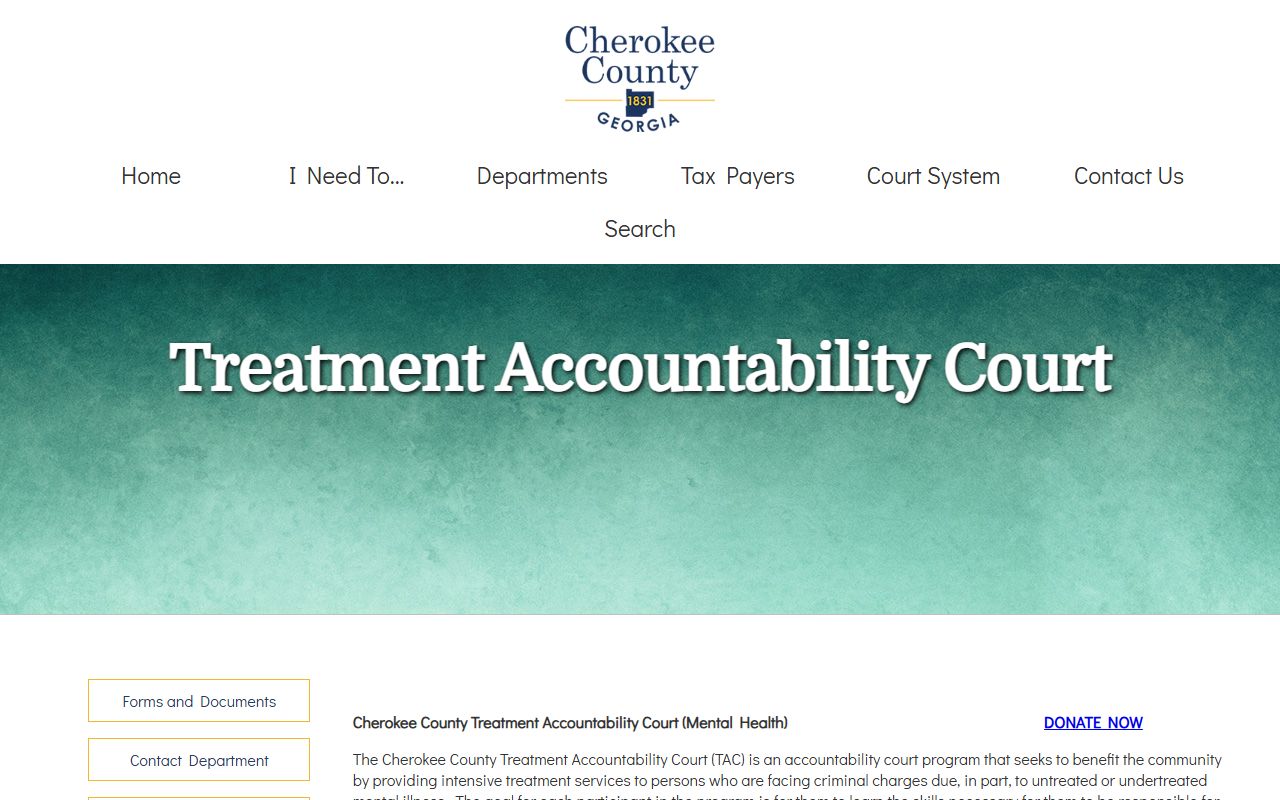
The page lays out the four phases of the program and the team structure. That graphic helps a new applicant understand what to expect before walking into Superior Court for a referral hearing.
The Veterans Treatment Court is a separate accountability court at 154 North Street in Canton. Judge Dee Morris presides. Coordinator Jenny Mehdikarimi runs day-to-day intake and case planning. Derek Grubb serves as case manager. The main line is 678-493-6585. The program serves veterans with criminal cases that link to service-related conditions. The Veterans Treatment Court contact page lists the full team and the intake steps.
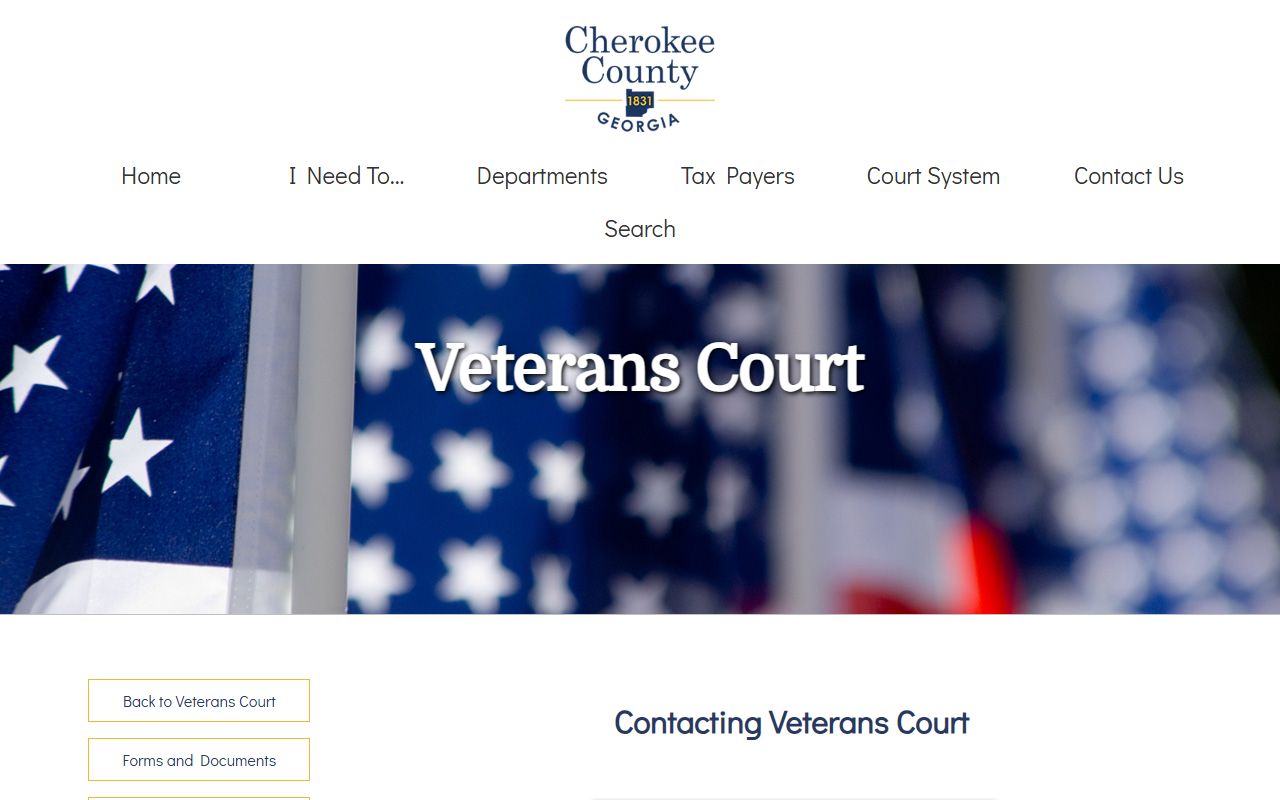
The contact page lists the address, the phone number, and the staff roster, all in one place. That makes it the first stop for a veteran considering the program.
Other accountability courts in Cherokee County include the Drug Accountability Court for felony drug cases, the DUI Court, the Misdemeanor Drug Court, and the Juvenile Drug Treatment Court. The Solicitor-General's office, led by Todd Hayes at 678-493-6360, helps run the misdemeanor side of the accountability docket. Indigent Defense at 678-493-6193 represents many participants. Each court has its own intake form and its own eligibility rules, but all of them share a treatment-first philosophy.
Federal Cases in Cherokee County (Northern District of Georgia)
Federal cases that arise out of Cherokee County go to the U.S. District Court for the Northern District of Georgia. The Superior Court has no role in those cases. Federal criminal prosecutions, federal civil rights claims, federal employment claims, and federal regulatory cases sit in federal court. The Northern District covers a wide swath of north Georgia. Its courthouses are in Atlanta, Newnan, Rome, and Gainesville. For Cherokee County matters, the Atlanta or Gainesville divisions are the usual venue.
The U.S. District Court for the Northern District of Georgia posts hearing schedules, judge assignments, and local rules.
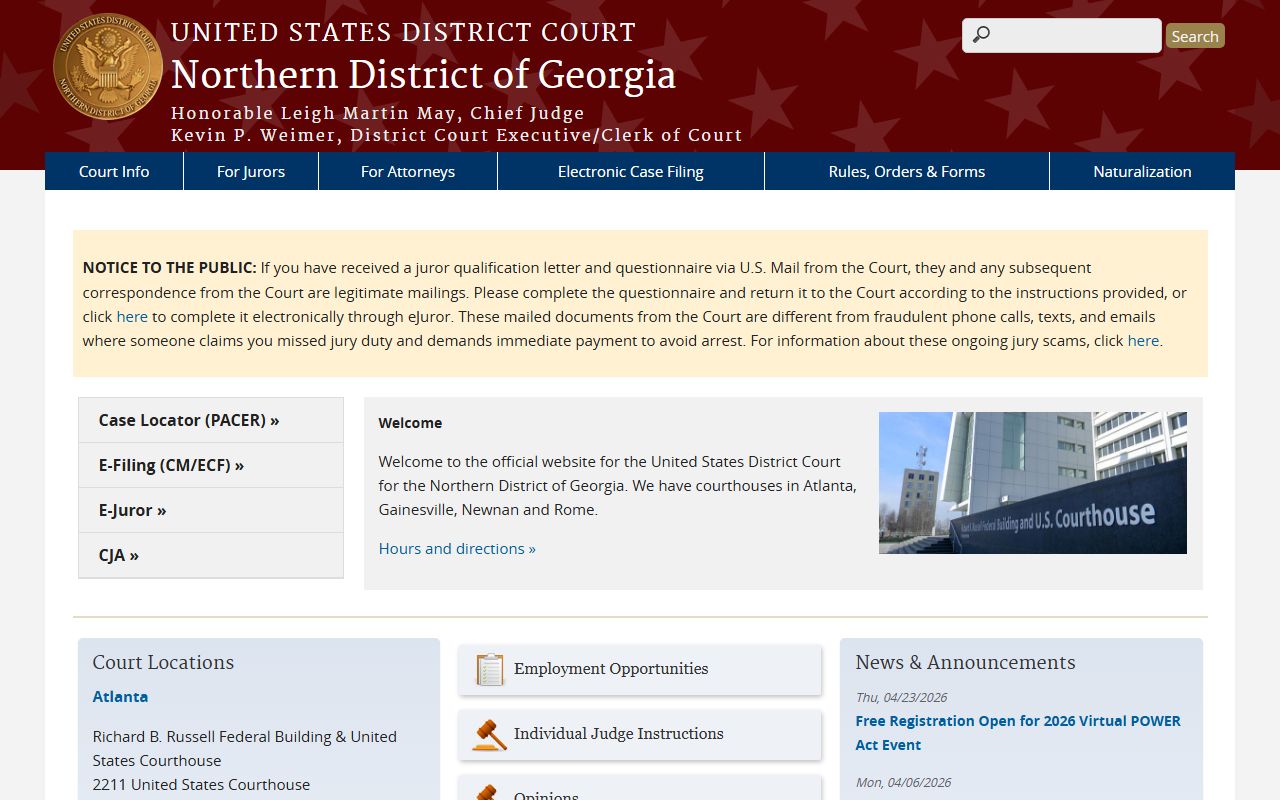
The site is the official source for federal trial court information and links out to PACER for case lookups.
Federal bankruptcy cases for Cherokee County go to the U.S. Bankruptcy Court for the Northern District of Georgia. The bankruptcy court is a separate Article I court that sits next to the District Court. It runs its own docket, its own filings, and its own clerk's office. People filing Chapter 7 or Chapter 13 cases use the federal bankruptcy clerk, not the Superior Court clerk.
The U.S. Bankruptcy Court for the Northern District of Georgia hosts forms, fees, and judge calendars on its site.
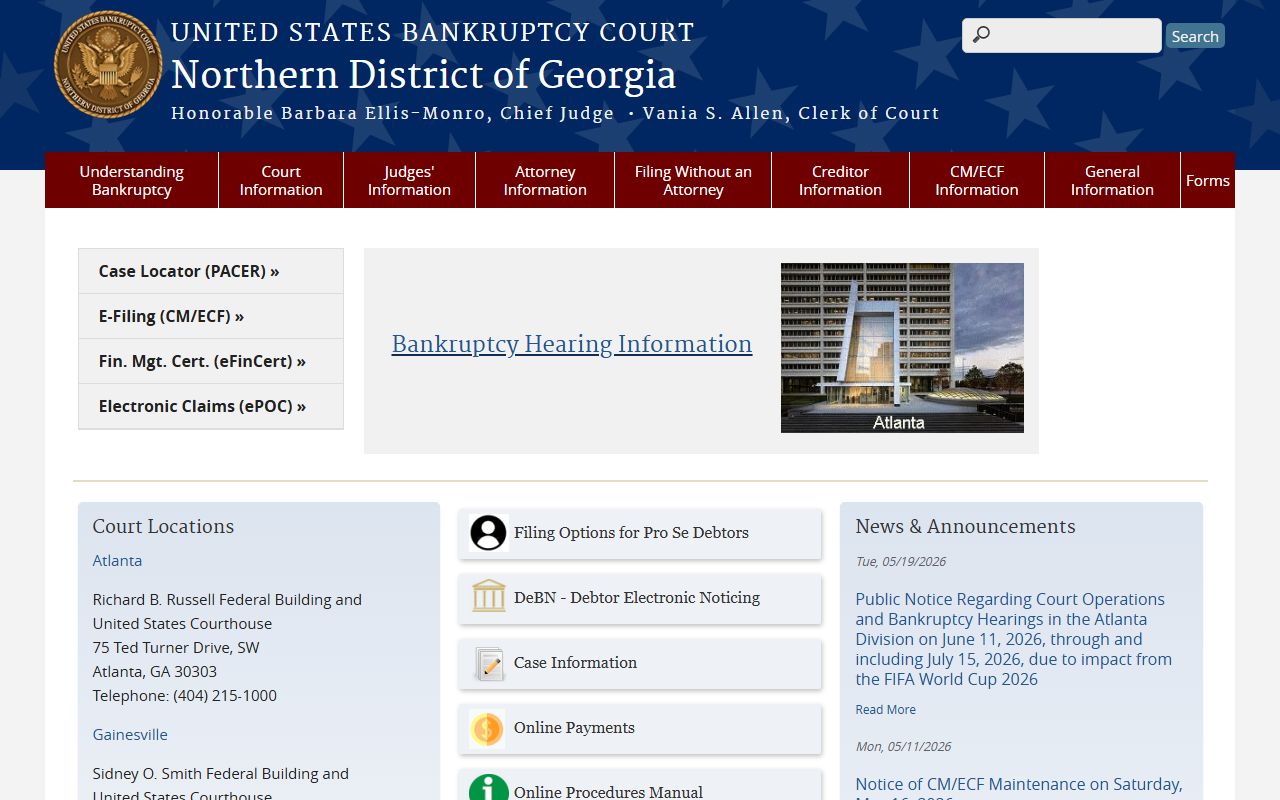
The home page lists local rules and links to the trustee directory and the means-test tables.
Federal prosecutions in the district come from the U.S. Attorney's Office. That office handles federal indictments, plea agreements, and trial work in the Northern District. The office also runs civil enforcement actions, including civil rights cases and forfeiture actions.
The U.S. Attorney's Office for the Northern District of Georgia publishes press releases on charges, pleas, and verdicts.
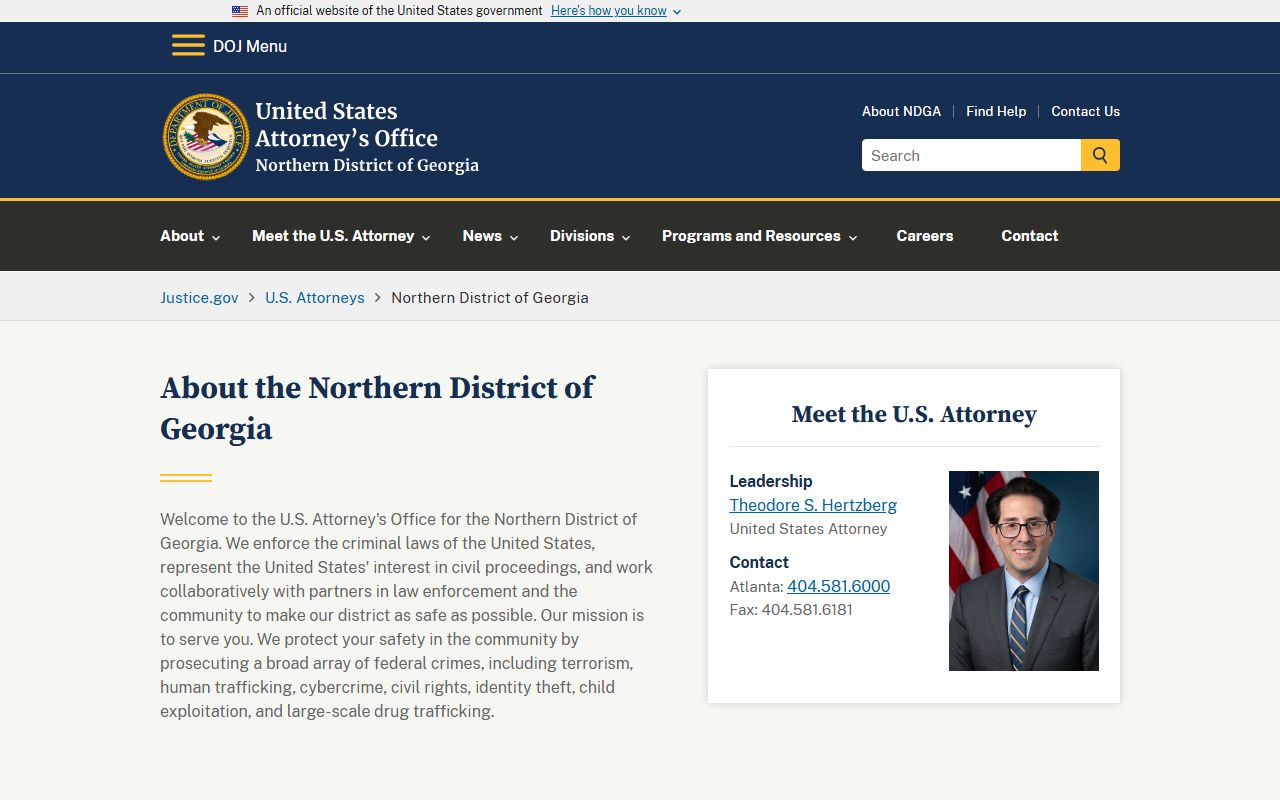
That press feed is the fastest way to find new federal cases tied to north Georgia counties, including Cherokee.
Appeals from the U.S. District Court go to the U.S. Court of Appeals for the Eleventh Circuit. The Eleventh Circuit covers Georgia, Alabama, and Florida. The U.S. Marshals Service for the Northern District of Georgia provides court security, prisoner transport, and warrant enforcement on the federal side. Public users can look up federal cases through PACER, which may charge a per-page fee. The current fee policy should be confirmed at pacer.gov before a search. The U.S. Attorney's Office and the federal docket on PACER do not connect to the state Superior Court system. They sit on a separate track.
Note: A federal case is filed in federal court even if the events behind it occurred in Cherokee County, because federal jurisdiction is set by subject matter, not by location alone.
Cherokee Superior Court Filing Path and Forms
Filing a case in Cherokee County Superior Court runs through the Clerk of Courts. The Clerk's office sits inside the Justice Center at 90 North Street, Canton. Office hours are 8:30 a.m. to 5:00 p.m., Monday through Friday. The Clerk handles civil filings, divorce filings, equity filings, criminal indictments, and land record filings under the same roof but in different divisions. Patty Baker leads the office.
Most attorneys file through eFileGA. Pro se litigants can file in person or use approved e-filing portals where available. The Superior Court Clerk's office page spells out the jurisdiction notes, hours, calendars, indictment lists, Rule 22 access rules, and copy purchasing details. Uniform Superior Court Rule 22 governs the use of electronic devices and any recording inside the courtroom. Each party must request approval in advance, and the rule applies whether the device is a phone, a tablet, or a camera.
Common Superior Court filings include the complaint, the divorce petition, criminal indictments returned by the grand jury, motions, briefs, and proposed orders. Many filings require a filing fee at submission. The Clerk publishes a fee schedule online and accepts payment by card or check. Indigent litigants can request a fee waiver under state rules. Forms for civil, criminal, domestic, magistrate, traffic, record restriction, and protective order use are posted in one place by the Clerk.
Cherokee County Superior Court contact card
Cherokee County Superior Court
Frank C. Mills III Justice Center
90 North Street
Canton, GA 30114
Court Administrator: Jody Overcash, Suite 250
678-493-6475
Hours: 8:30 a.m. to 5:00 p.m., Monday through Friday
For case search help on the Superior Court docket, see the court records page. For warrants and warrants-related Superior Court orders, see the warrant records page. For inmates currently in custody on Superior Court charges, see the inmate records page. For traffic matters that escalate out of State Court, see the traffic court records page. For divorce and marriage filings, see the marriage and divorce records page. For broader open-records guidance under Georgia law, see the public records page. For follow-up questions, the FAQ covers the most common Cherokee County Superior Court topics. For criminal case context, the criminal records page collects DA, Indigent Defense, and GBI links in one spot.
Note: Filing fees and form versions change from time to time, so always check the Clerk's current schedule before mailing a payment.