
How to Look Up Cherokee County Jail Population Data
Cherokee County jail population data lives in a few places. The most authoritative source is the Cherokee Sheriff's Office, which runs the Adult Detention Center and publishes facility detail through its public site. The jail accreditation page hosts the American Correctional Association visiting committee report, which is the public document with the most current structural and staffing detail for the ADC. National benchmarks for the county come from the Bureau of Justice Statistics jail series and the Vera Institute incarceration trends data set.
Different sources update on different clocks. The Sheriff's live roster moves throughout the day. The ACA report covers a fixed audit window and gets refreshed when the agency re-accredits. BJS jail counts publish on an annual cycle. That gap matters when a number looks off. A booking-day spike on the live roster will not show up in a BJS table for many months. Each source is read against its own time stamp, not blended into one figure.
Cherokee County Jail Capacity Overview
The Cherokee County Adult Detention Center is the only full-service jail in the county. Municipal departments such as Canton Police, Woodstock Police, Holly Springs Police, and Ball Ground Police hold arrestees briefly in temporary holding rooms before transport. All long-term custody runs through the ADC. The facility serves the Sheriff's Office, Georgia State Patrol, Department of Natural Resources, the four city departments above, and the Cherokee County School District Police.
The ADC structure has grown in two waves. The original 1989 building was sized for the population of that era. A first expansion finished in 2002. A second, much larger expansion opened in 2021 and added housing, dayrooms, control towers, exercise yards, and renovated kitchen, dining, laundry, visitation, lobby, and master control areas. The expansion uses modular precast housing and new electronic security tied back to the Master Control center.
The capacity table below pulls structural detail from the jail accreditation page and the ACA 2025 visiting committee report. A specific total bed count is not stated in the extracted official text, so the count column is left descriptive.
| Facility | Address | Capacity / Structure | Source |
|---|---|---|---|
| Cherokee County Adult Detention Center | 498 Chattin Drive, Canton, GA 30115 | Opened 1989; expansions in 2002 and 2021; adult males and females age 17 and over; six direct observation housing units and a 27-bed medical infirmary in the original facility; 2021 expansion adds 14 housing units, 21 dayrooms, internal control towers, and three exercise yards. | ACA 2025 report |
| Municipal temporary holding areas | Local police departments (Canton, Woodstock, Holly Springs, Ball Ground) | Not full-service jail space. The ADC is the only full-service jail in Cherokee County. Holding rooms hold arrestees during processing only. | ACA 2025 report |
Average Daily Population
Average daily population, or ADP, is the mean count of people held in the jail across all days of a year. ADP smooths out booking spikes and weekend swings. It is the figure most often used in county budget books and state corrections reports.
An official Cherokee County ADP is not stated in the public ACA 2025 report or the Sheriff site text that was reviewed. The official ACA document covers facility structure, staffing categories, and accreditation status, but not a single-line ADP figure. Several unofficial roster sites publish ADP estimates near 498 with a rated capacity near 512. Those figures are not used here because the source is not an official county or state record. The county or state should be consulted for a cited ADP before any chart is built.
Note: County ADP and bed counts may live in the Sheriff annual report or the Cherokee County budget book; both fall outside the official pages reviewed for this build.
Demographic Breakdown
Cherokee County jail demographics start with the population served by the agencies that book into the ADC. The Sheriff's Office home page says the agency serves more than 299,000 people. The ADC holds adults age 17 and over of both sexes. A line-by-line race, age, and sex breakdown of the live custody count is not published as a public table in the materials reviewed. The qualitative table below pulls indicators that are stated in official sources.
| Indicator | Source / Notes |
|---|---|
| Sheriff's served population: more than 299,000 | Sheriff home page |
| Adult age threshold: 17 years and older | ACA 2025 visiting committee report |
| Triple Crown accredited (ACA, CALEA, NCCHC) | Jail accreditation page |
| NCCHC re-accreditation: April 2023 | Jail accreditation page |
| Staff snapshot (Sheriff's Office context): about 29 administrative, 41 support, 390 sworn, 10 program, 24 other | ACA 2025 visiting committee report |
The staff snapshot covers the broader Sheriff's Office, not just the jail. A jail-only headcount is not stated as a line item in the extracted text. The staff mix still matters for population work because sworn deputies move custody, and program staff run the in-house programming that affects sentenced inmate flow.
Pretrial vs Sentenced Population
Pretrial inmates are people who have been booked but have not been convicted. Sentenced inmates are serving a court-ordered term. The split matters because pretrial cases turn over quickly while sentenced cases sit for weeks or months.
Cherokee County Magistrate Court operates 24 hours a day, 365 days a year. After-hours judges handle initial appearance and bail hearings for every person booked into the ADC. That intake flow means each new arrestee moves through Magistrate Court before any later step. Bail decisions made at first appearance directly shape the pretrial share of the jail count. A high cash-bond rate pushes pretrial up. A high release-on-recognizance rate pulls it down.
An official current split between pretrial and sentenced detainees at the ADC is not stated in the reviewed county or state pages. The live roster does not publish that split as a single percentage. BJS and Vera report that across Georgia and the nation, pretrial usually accounts for roughly two thirds of local jail populations, with the rest serving short county sentences. Cherokee County is expected to track within that range, but a county-cited percentage was not located.
Note: A cited pretrial-versus-sentenced number for the ADC requires a Sheriff or Magistrate Court report; the public Jail List does not show it.
Misdemeanor vs Felony Population
Charge type drives where a case goes after Magistrate Court. Misdemeanors flow to State Court for prosecution by the Solicitor-General. Felonies flow to Superior Court for grand jury action and prosecution by the District Attorney. The jail holds both groups during the pretrial phase.
The court routing inside Cherokee County looks like this: Magistrate Court handles intake, first appearance, bail, and search and arrest warrants. State Court handles misdemeanors, traffic, and limited civil matters. Superior Court handles felonies along with divorce, equity, and land title. Sentenced inmates at the ADC are usually State Court misdemeanants or Superior Court probationers serving short revocation time. People with longer felony sentences are transferred out to the Georgia Department of Corrections.
A current charge-type breakdown of the ADC count is not stated in the reviewed public pages. Charge text is visible on the live Jail List in case-by-case form, but no aggregated misdemeanor-versus-felony percentage is published as a county statistic.
Mental Health and Medical Population
Cherokee ADC runs in-house medical, dental, and mental health services through Correct Health. The original facility has a 27-bed medical infirmary that handles ongoing care, intake screening, and isolation when needed. Medical inquiries go to 678-493-4547.
Health staffing and protocols are tied to the National Commission on Correctional Health Care, or NCCHC. Cherokee ADC has participated in NCCHC accreditation since 2004 and was re-accredited in April 2023. NCCHC standards cover screening at booking, chronic care, mental health care, suicide prevention, and medication management. That framework shapes how many infirmary beds are needed at any time and how many inmates carry a mental health flag in custody.
Cherokee County also runs a Treatment Accountability Court, or TAC, which was established in December 2015. By May 2024, TAC had produced 54 graduates. TAC pulls a share of substance-use cases out of jail and into structured treatment. The TAC program page describes the model. The Cherokee Drug Lab at 100 N Street, Suite G23 operates from 6 a.m. to 11 a.m. seven days a week and supports the testing piece of accountability supervision.
National and State Context
National and state context is built from Bureau of Justice Statistics jail data and Vera Institute incarceration trends. BJS reports jail populations and incarceration rates per 100,000 residents by state and at the national level. Vera publishes county-level trend lines drawn from federal collections. Both data sets lag the live local roster by months or years, but they put the local count in scale.
The table below compares the county rate against state and national rates per 100,000 residents. A cited Cherokee County rate is not in the reviewed official text, so the county row is descriptive. The state and national rows are framed against BJS and Vera context. Specific year-by-year rates should be pulled from the latest BJS jail inmates report before any chart is published.
| Level | Jail Population per 100,000 | Source / Notes |
|---|---|---|
| Cherokee County | Not stated in reviewed official documents | Sheriff and ACA materials cover structure and staffing, not a per-capita jail rate. |
| Georgia (state) | Refer to latest BJS state jail series | BJS Jail Inmates annual reports break out Georgia counts and rates. |
| National | Refer to latest BJS national jail series | BJS Jail Inmates annual reports give the all-counties national rate. |
Population Trends Over Time
The Cherokee ADC opened in 1989. That date sets the start of any local trend line. The first expansion completed in 2002 marked the first major capacity increase. A second expansion completed in 2021 added a much larger block of housing units, dayrooms, and security infrastructure. Capacity events drive jail population step changes because each new wing changes how many beds the county has to fill.
The 2021 expansion is the most recent shift. It brought 14 new housing units, 21 dayrooms, internal control towers, three exercise yards, expanded access road work, and renovations to the kitchen, staff dining, laundry, visitation, lobby, and master control. Electronic security was tied back to Master Control with a new system. That work signals the agency planned for a larger population horizon than the 1989 footprint.
The image below shows the Cherokee Sheriff's Office home page where Sheriff Frank Reynolds, agency mission, and quick links to the jail sit. The home page is the entry point for almost every public population question.
The Cherokee Sheriff's Office home page lists the agency leadership and the main jail contact.

The page links to the Adult Detention Center, the inmate list, and accreditation, which together give the public the building blocks for a population read across years.
A year-by-year ADP series for the ADC is not stated in the public text reviewed. A long-run series would need to come from Sheriff annual reports or county budget books that itemize jail operating costs and counts.
Searching for Cherokee County Inmate Records by Name
This page covers aggregate jail population data. Name-by-name lookups of the live ADC roster go through the separate Cherokee County inmate records page. That page covers the Jail List portal, the search-field setup, and the field inventory returned for each booking. For post-release status checks, use released inmates.
Where the Data Comes From
Population data on this page is sourced from official Cherokee County and state materials. The capacity and structure rows come from the ACA 2025 visiting committee report hosted on the Sheriff's site. The accreditation indicators come from the jail accreditation page. The booked-population context comes from the Sheriff's Office home page and the inmate services page.
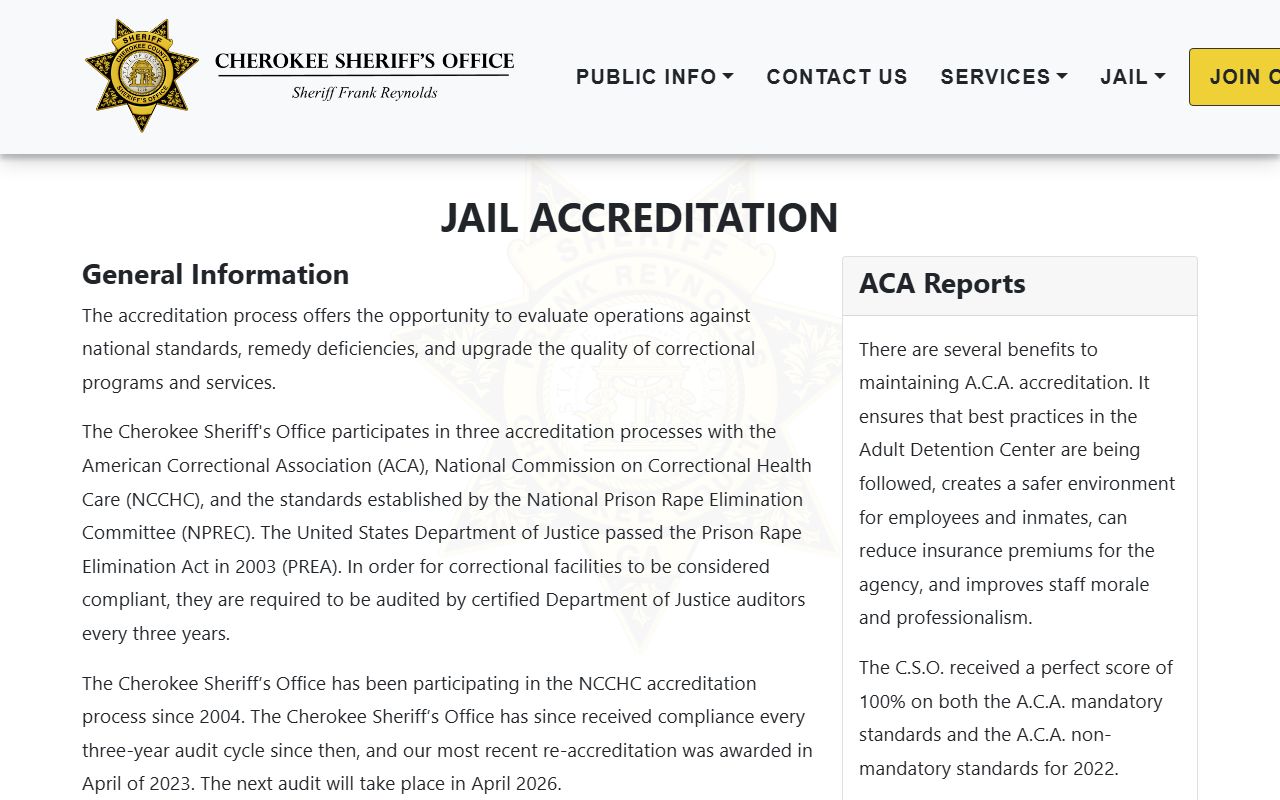
The accreditation page is the document that proves the ADC meets ACA, CALEA, and NCCHC standards. It is also where the public can find the NCCHC re-accreditation date of April 2023. The image below shows that accreditation page directly.
The jail accreditation page documents the Triple Crown status that frames how the jail population is housed.
National and state context comes from the Bureau of Justice Statistics and Vera Institute incarceration data sets. The live Jail List is the source for case-level booking activity. For court-side context, the Cherokee County court records page covers the docket side of the same flow, and the public records page covers Georgia open-records procedure. For warrants behind many of those bookings, see warrant records, and for the felony side that routes to Superior Court, see criminal records. Common population questions are addressed on the FAQ page, and court date listings sit on the court dockets page.
Note: Where a number is not cited in an official Cherokee County or Georgia document, it is left descriptive on this page rather than estimated.